
You’ve probably heard the buzz—Bitcoin hitting new all-time highs, billionaires calling it “digital gold,” and early investors becoming millionaires overnight. But what actually is Bitcoin, and why does it matter to you?
Whether you’re completely new to cryptocurrency or looking to finally understand what all the hype is about, this guide breaks down everything you need to know about Bitcoin. No confusing jargon, no assumptions, just clear explanations that make sense.
By the end of this guide, you’ll understand how Bitcoin works, why it was created, and whether it deserves a place in your financial future.

What is Bitcoin? The Simple Explanation
Bitcoin (BTC) is a decentralized digital currency that allows people to send and receive money directly to each other over the internet without needing a bank, government, or any middleman to process the transaction.
Think of it like digital cash. Just as you can hand physical cash to someone without a bank knowing about it, Bitcoin lets you transfer value digitally with the same level of directness. The key difference? Bitcoin transactions are recorded on a public ledger called the blockchain, making them transparent and virtually impossible to fake or reverse.
Key Characteristics of Bitcoin
Decentralized: No single company, government, or institution controls Bitcoin. It’s maintained by a global network of computers (called nodes) that all work together to verify transactions.
Limited Supply: There will only ever be 21 million Bitcoins in existence. This built-in scarcity is one reason many compare it to gold. You can’t just print more of it.
Digital and Borderless: Bitcoin exists purely online and can be sent anywhere in the world within minutes, regardless of borders, bank hours, or international regulations.
Pseudonymous: While all transactions are public, they’re tied to cryptographic addresses rather than personal identities. You can see that Address A sent money to Address B, but you won’t necessarily know who owns those addresses.
Irreversible: Once a Bitcoin transaction is confirmed on the blockchain, it cannot be undone. This eliminates chargebacks and fraud but also means you need to be careful when sending.
The History of Bitcoin: How It All Started
Bitcoin’s origin story reads like a tech thriller—an anonymous creator, a revolutionary idea, and timing that couldn’t have been more perfect.
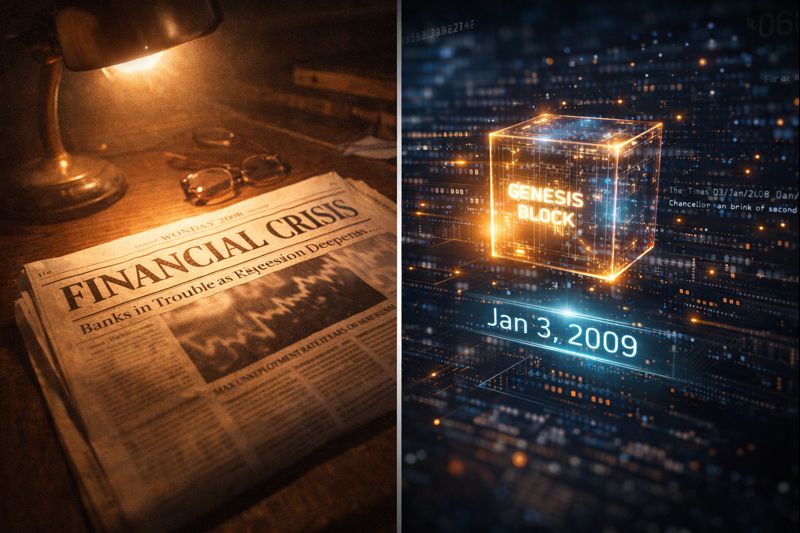
The 2008 Financial Crisis and a New Vision
On October 31, 2008, in the midst of the worst financial crisis since the Great Depression, a person or group using the pseudonym Satoshi Nakamoto published a nine-page whitepaper titled “Bitcoin: A Peer-to-Peer Electronic Cash System.”
The timing was no coincidence. Banks were failing, governments were printing money to bail them out, and trust in traditional financial institutions had collapsed. Nakamoto’s whitepaper proposed something radical: a currency that didn’t require trust in banks or governments at all.
The Genesis Block: Bitcoin Goes Live
On January 3, 2009, Nakamoto mined the first-ever Bitcoin block, known as the Genesis Block or Block 0. Embedded in this block was a message: “The Times 03/Jan/2009 Chancellor on brink of second bailout for banks”—a reference to a newspaper headline that day, forever linking Bitcoin’s birth to the failures of traditional finance.
Major Milestones in Bitcoin’s History
2010 – First Real-World Transaction: Programmer Laszlo Hanyecz paid 10,000 BTC for two pizzas—worth about $41 at the time. Today, that same amount would be worth hundreds of millions of dollars. May 22 is now celebrated as “Bitcoin Pizza Day.”
2011 – Bitcoin Reaches Parity with the Dollar: For the first time, 1 BTC equaled $1 USD, proving the concept had real-world value.
2013 – First Major Bull Run: Bitcoin surged past $1,000, attracting mainstream media attention for the first time.
2017 – The ICO Boom: Bitcoin reached nearly $20,000 as cryptocurrency fever gripped the world and thousands of new projects launched.
2020-2021 – Institutional Adoption: Major corporations like Tesla, MicroStrategy, and Square began adding Bitcoin to their balance sheets. El Salvador made Bitcoin legal tender, a world first.
2024 – Bitcoin ETF Approval: The U.S. SEC approved spot Bitcoin ETFs, opening the floodgates for traditional investors to gain exposure to BTC through their regular brokerage accounts.
How Does Bitcoin Work? Understanding the Technology
At its core, Bitcoin solves a problem that had stumped computer scientists for decades: how do you create digital money that can’t be copied or spent twice, without relying on a central authority to keep track?

The Double-Spend Problem
Digital files can be copied infinitely. If digital money worked like a regular file, you could send the same dollar to ten different people, making it worthless. Traditional systems solve this with banks that maintain centralized ledgers. Bitcoin solves it differently: with a distributed ledger that everyone can see and verify.
How a Bitcoin Transaction Works
Let’s say you want to send 0.1 BTC to a friend. Here’s what happens behind the scenes:
Step 1 – You Initiate the Transaction: Using your Bitcoin wallet, you create a transaction that says “Send 0.1 BTC from my address to my friend’s address.” Your wallet signs this transaction with your private key—a secret code that proves you own the Bitcoin.
Step 2 – The Transaction is Broadcast: Your signed transaction is sent out to the Bitcoin network, where thousands of computers (nodes) receive it.
Step 3 – Verification: Nodes check that your signature is valid and that you actually have 0.1 BTC to send. Invalid transactions are rejected.
Step 4 – Mining and Confirmation: Valid transactions wait in a pool called the “mempool” until miners include them in a block. Once your transaction is in a confirmed block, it’s added to the blockchain permanently.
Step 5 – Completion: Your friend’s wallet shows the incoming 0.1 BTC. After a few more blocks are added on top, the transaction is considered fully confirmed and irreversible.
What is Blockchain? The Foundation of Bitcoin
The blockchain is the technology that makes Bitcoin possible. It’s a distributed database that maintains a continuously growing list of records (blocks) that are linked together cryptographically.

Breaking Down the Blockchain
Blocks: Imagine a block as a page in a ledger book. Each block contains a batch of transactions (typically 1,500-2,500), a timestamp, and a reference to the previous block.
Chain: Each block contains a cryptographic “fingerprint” (called a hash) of the previous block. This chains them together in chronological order. If anyone tried to alter a past transaction, it would change that block’s hash, which would break the chain, immediately revealing the tampering.
Distributed: The blockchain isn’t stored in one place. Thousands of computers around the world each maintain a complete copy. To hack Bitcoin, you’d need to simultaneously alter the records on more than half of these computers, a practically impossible task.
Why Blockchain Matters
The blockchain provides three crucial properties that make Bitcoin trustworthy:
Transparency: Anyone can view any transaction ever made on Bitcoin. This public accountability makes fraud nearly impossible.
Immutability: Once data is written to the blockchain, it cannot be changed or deleted. This permanence creates an unimpeachable record of truth.
Decentralization: No single point of failure exists. Even if hundreds of nodes went offline, the network would continue operating normally.
Bitcoin Mining Explained
Bitcoin mining is the process by which new transactions are verified and added to the blockchain, and new Bitcoins are created. Despite the name, it has nothing to do with pickaxes, it’s all about computing power.

What Do Miners Actually Do?
Miners compete to solve complex mathematical puzzles. The first miner to solve the puzzle gets to add the next block of transactions to the blockchain and receives a reward: newly created Bitcoin plus transaction fees from the transactions in that block.
This puzzle-solving process is called Proof of Work (PoW). It requires significant computational power, which means miners must invest in specialized hardware and electricity. This investment makes attacking the network extremely expensive and economically irrational.
The Mining Reward and Halving
When Bitcoin launched, miners received 50 BTC for each block. Every 210,000 blocks (approximately every four years), this reward is cut in half, an event called the “halving.”
The halvings so far: 50 BTC (2009) → 25 BTC (2012) → 12.5 BTC (2016) → 6.25 BTC (2020) → 3.125 BTC (2024)
This decreasing supply schedule is a key part of Bitcoin’s value proposition. As new supply diminishes while demand grows, basic economics suggests upward price pressure.
Can You Mine Bitcoin at Home?
In Bitcoin’s early days, you could mine profitably with a regular laptop. Today, the competition has become so intense that profitable mining requires specialized hardware called ASICs (Application-Specific Integrated Circuits) and access to cheap electricity. Most individual miners now join “mining pools” to combine their computing power and share rewards proportionally.
Bitcoin Wallets: Storing Your BTC Safely
A Bitcoin wallet is software (or hardware) that stores your private keys and allows you to send and receive Bitcoin. Despite the name, it doesn’t actually “store” your Bitcoin, your coins always live on the blockchain. The wallet just holds the keys that prove you own them.
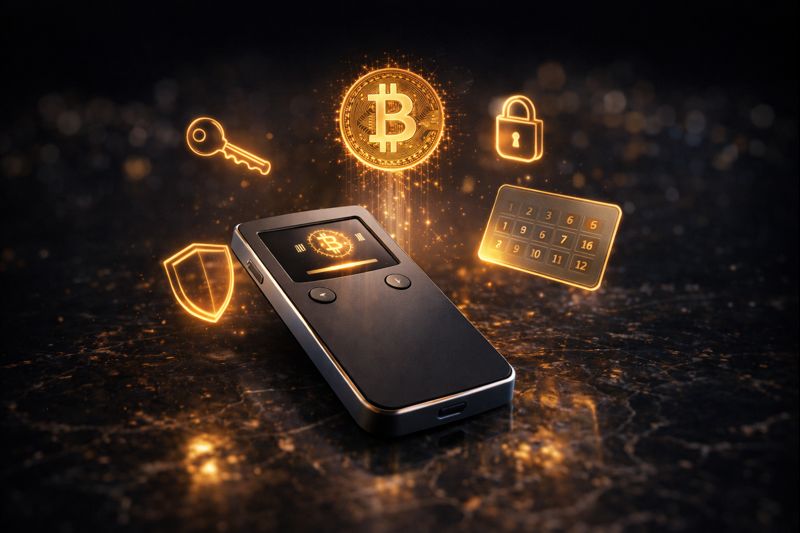
Public Keys vs. Private Keys
Public Key (Address): This is like your bank account number, you can share it with anyone who wants to send you Bitcoin. It’s a long string of letters and numbers that looks something like: 1BvBMSEYstWetqTFn5Au4m4GFg7xJaNVN2
Private Key: This is like your bank account password, it must be kept secret at all costs. Anyone with your private key can spend your Bitcoin. If you lose your private key, you lose access to your funds forever.
Types of Bitcoin Wallets
Hot Wallets (Connected to Internet):
- Mobile Wallets: Apps like Trust Wallet or BlueWallet. Convenient for everyday use and small amounts.
- Desktop Wallets: Software like Electrum or Bitcoin Core. More features and control than mobile options.
- Web Wallets: Accessed through a browser. Convenient but you’re trusting the website operator.
- Exchange Wallets: Keeping your Bitcoin on exchanges like Coinbase or Kraken. Easy to trade but you don’t control the keys (“not your keys, not your coins”).
Cold Wallets (Offline Storage):
- Hardware Wallets: Physical devices like Ledger or Trezor. Considered the gold standard for security. Your private keys never touch the internet.
- Paper Wallets: Your keys printed on paper. Extremely secure from hacking but vulnerable to physical damage or loss.
Best Practices for Wallet Security
Backup your seed phrase: Most wallets generate a 12 or 24-word recovery phrase. Write this down on paper (not digitally) and store it somewhere safe. This phrase can restore your wallet if your device is lost or damaged.
Use hardware wallets for significant amounts: If you’re holding more than you’d be comfortable losing, invest in a hardware wallet.
Enable all available security features: Two-factor authentication, PIN codes, and biometric locks add extra layers of protection.
How to Buy Bitcoin: A Step-by-Step Process
Ready to get your first Bitcoin? Here’s exactly how to do it safely.
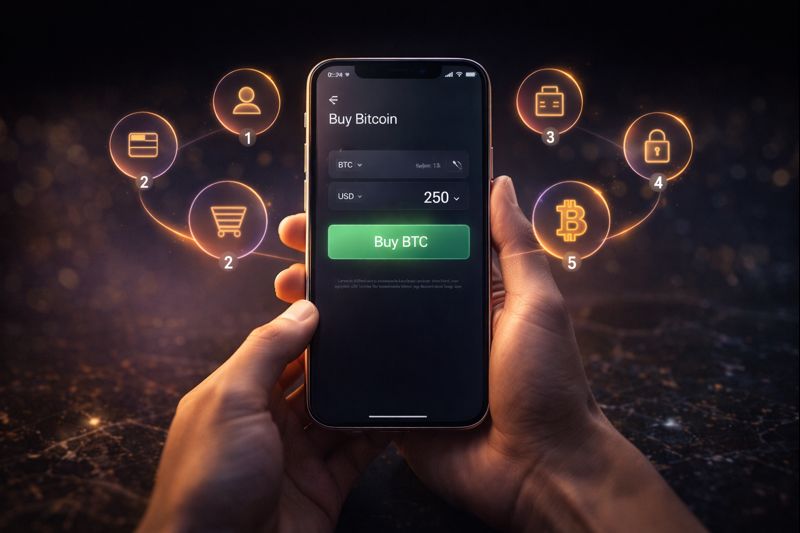
Step 1: Choose a Reputable Exchange
Cryptocurrency exchanges are platforms where you can buy, sell, and trade Bitcoin. Popular options include:
- Coinbase: User-friendly interface, ideal for beginners. Higher fees but excellent security and insurance.
- Kraken: Lower fees, strong security track record, good for intermediate users.
- Binance: Lowest fees, most trading options, but more complex interface.
- Gemini: Strong regulatory compliance, good for institutional or security-conscious investors.
Step 2: Create and Verify Your Account
Sign up with your email and create a strong, unique password. Most exchanges require identity verification (KYC) before you can buy, you’ll typically need to provide a government ID and proof of address.
Step 3: Add a Payment Method
Connect your bank account, debit card, or credit card. Bank transfers usually have lower fees but take longer. Cards are instant but come with higher fees.
Step 4: Place Your Order
Decide how much you want to buy. You don’t need to buy a whole Bitcoin, you can purchase fractions down to 0.00000001 BTC (called a “satoshi”). Enter the amount and confirm your purchase.
Step 5: Secure Your Bitcoin
If you’re holding for the long term, consider transferring your Bitcoin to a personal wallet rather than leaving it on the exchange. Remember: exchanges can be hacked, freeze accounts, or go bankrupt.
Advantages and Risks of Bitcoin
Why People Are Bullish on Bitcoin
Store of Value: With a capped supply and increasing adoption, many view Bitcoin as “digital gold”—a hedge against inflation and currency devaluation.
Financial Freedom: Bitcoin can’t be frozen, seized, or censored by governments. For people in countries with unstable currencies or authoritarian regimes, this is life-changing.
Transparency and Security: The blockchain provides unprecedented transaction transparency while cryptography ensures security.
Growing Institutional Adoption: Major corporations, hedge funds, and even countries are now holding Bitcoin, lending it credibility as an asset class.
24/7 Global Market: Unlike traditional stock markets, Bitcoin trades around the clock, every day of the year.
Risks You Should Understand
Extreme Volatility: Bitcoin’s price can swing 10-20% in a single day. In 2022, it dropped from $69,000 to below $16,000. This volatility isn’t for the faint of heart.
Regulatory Uncertainty: Governments worldwide are still figuring out how to regulate cryptocurrency. New laws could impact Bitcoin’s price and utility.
Technical Complexity: Managing private keys and navigating the crypto ecosystem has a learning curve. Mistakes can be costly and irreversible.
Environmental Concerns: Bitcoin mining consumes significant electricity, drawing criticism from environmentalists, though the industry is increasingly shifting toward renewable energy.
No Consumer Protections: Unlike bank accounts, Bitcoin has no FDIC insurance. If you lose access to your wallet or get scammed, there’s no customer service to call.
Bitcoin vs. Traditional Currency: Key Differences
| Feature | Bitcoin | Traditional Currency (USD, EUR, etc.) |
|---|---|---|
| Control | Decentralized (no single authority) | Centralized (controlled by central banks) |
| Supply | Fixed at 21 million | Unlimited (can be printed) |
| Inflation | Deflationary by design | Typically inflationary |
| Transaction Speed | 10-60 minutes for confirmation | Instant to several days (wire transfers) |
| Transaction Costs | Variable (can be high during congestion) | Variable (often percentage-based) |
| Operating Hours | 24/7/365 | Limited by bank hours and holidays |
| Cross-Border Payments | Same as domestic | Complex, slow, and expensive |
| Privacy | Pseudonymous | Linked to personal identity |
| Reversibility | Irreversible once confirmed | Can be reversed (chargebacks) |
The Future of Bitcoin: Where Is It Headed?
Predicting Bitcoin’s future is impossible, but several trends are shaping its trajectory.

Increasing Institutional Adoption
The approval of Bitcoin ETFs in 2024 marked a watershed moment. Traditional investors can now gain Bitcoin exposure through their retirement accounts and regular brokerages. This mainstream accessibility could drive demand significantly higher.
Layer 2 Solutions: The Lightning Network
Bitcoin’s base layer can only process about 7 transactions per second (compared to Visa’s 24,000). The Lightning Network is a “layer 2” solution that enables instant, nearly-free Bitcoin transactions by handling them off-chain. As Lightning adoption grows, Bitcoin becomes more practical for everyday payments.
Global Regulatory Landscape
Countries are taking divergent approaches from El Salvador’s full embrace to China’s complete ban. How major economies like the US and EU ultimately regulate cryptocurrency will significantly impact Bitcoin’s future.
The Next Halving and Beyond
With each halving, new Bitcoin supply decreases. Some analysts believe this programmed scarcity, combined with growing demand, could drive prices significantly higher over time. Others caution that past performance doesn’t guarantee future results.
Beyond Bitcoin: Exploring the Wider Cryptocurrency Ecosystem
While Bitcoin remains the largest and most well-known cryptocurrency often called the “king of crypto”—it’s just one piece of a much larger puzzle. The success and technology pioneered by Bitcoin has inspired thousands of other digital assets, each designed to solve different problems or serve unique purposes.
These alternative cryptocurrencies, commonly known as “altcoins” (alternative coins), have become a significant part of the crypto landscape. Some focus on faster transactions, others on smart contracts and decentralized applications, and still others on privacy or specific industry use cases.
Understanding Bitcoin gives you a solid foundation, but to truly grasp the full potential of cryptocurrency technology, you’ll want to explore what else is out there. Projects like Ethereum, Solana, Cardano, and countless others are building on Bitcoin’s revolutionary ideas in fascinating ways, some offering features that Bitcoin itself wasn’t designed to provide.
If you’re curious about what lies beyond Bitcoin and want to understand the opportunities (and risks) in the broader crypto market, we’ve put together a comprehensive guide: What Are Altcoins? A Beginner’s Guide to the World Beyond Bitcoin. It covers everything from how altcoins differ from Bitcoin to the major categories you should know about, and how to evaluate whether they deserve a place in your portfolio.
Frequently Asked Questions About Bitcoin
Is Bitcoin legal?
Bitcoin is legal in most countries, including the United States, Canada, European Union nations, Japan, and Australia. However, some countries have restricted or banned it, including China and a handful of others. Always check your local regulations before buying.
Can I buy less than one Bitcoin?
Absolutely! Bitcoin is divisible to eight decimal places. The smallest unit (0.00000001 BTC) is called a “satoshi.” You can start with as little as $10 or $20 on most exchanges.
Is Bitcoin a good investment?
Bitcoin has been one of the best-performing assets of the past decade, but past performance doesn’t guarantee future returns. It’s highly volatile and risky. Never invest more than you can afford to lose, and consider it as part of a diversified portfolio rather than a get-rich-quick scheme.
Who controls Bitcoin?
No one controls Bitcoin, that’s the point. It’s maintained by a global network of nodes and miners who follow the protocol’s rules. Changes to Bitcoin require broad consensus among developers, miners, and users.
Can Bitcoin be hacked?
The Bitcoin network itself has never been hacked in its 15+ year history. The cryptography protecting it is extremely robust. However, individual wallets and exchanges can be compromised through phishing, malware, or poor security practices. Your security is your responsibility.
What happens when all 21 million Bitcoin are mined?
The last Bitcoin is expected to be mined around the year 2140. After that, miners will be compensated entirely through transaction fees rather than block rewards. The network is designed to be sustainable long-term.
Is Bitcoin anonymous?
Bitcoin is pseudonymous, not anonymous. Transactions are public and can potentially be traced. While your name isn’t attached to your address, sophisticated analysis can sometimes link addresses to real identities. For greater privacy, some users employ mixing services or privacy-focused cryptocurrencies.
Final Thoughts: Is Bitcoin Right for You?
Bitcoin represents one of the most significant financial innovations of our lifetime. Whether it becomes the future of money, a digital store of value like gold, or something else entirely, it has already changed how we think about currency, trust, and financial sovereignty.
For beginners, the most important thing is to start learning before you start investing. Understand the technology, the risks, and your own financial goals. Start small, secure your holdings properly, and never invest money you can’t afford to lose.
The cryptocurrency journey is a marathon, not a sprint. Bitcoin was just the beginning, the technology and ecosystem are evolving rapidly. Stay curious, stay cautious, and keep learning.
Ready to expand your crypto knowledge? Learn about the thousands of other digital assets in our complete guide to altcoins and alternative cryptocurrencies.
