

You’ve probably seen it everywhere on CoinMarketCap, CoinGecko, exchange apps, and crypto news headlines: “Bitcoin’s market cap hits $2 trillion” or “Total crypto market cap reaches all-time high.”
But what does market cap actually mean? Why do investors obsess over it? And more importantly, how can understanding this single metric make you a smarter crypto investor?
Market capitalization or “market cap” for short, is one of the most important tools for evaluating cryptocurrencies. It tells you the total value of a crypto project, helps you compare different coins on equal footing, and gives you insight into risk levels you might not see from price alone.
What Is Market Cap in Crypto?

Market capitalization is the total dollar value of a cryptocurrency. It represents the combined worth of all coins or tokens currently in circulation, essentially telling you how “big” a crypto project is in monetary terms.
Think of it this way: if you wanted to buy every single Bitcoin in existence at today’s price, the market cap tells you how much that would cost.
Market cap isn’t unique to crypto, it’s borrowed from traditional finance, where it’s used to measure the size of publicly traded companies. Apple, for example, has a market cap of over $3 trillion, making it one of the world’s most valuable companies. In the same way, Bitcoin’s market cap of approximately $1.9–2 trillion (as of late 2025) makes it the largest and most valuable cryptocurrency.
New to Bitcoin and want to understand the fundamentals first? Start with our Complete Beginner’s Guide to Bitcoin.
How Market Cap Is Calculated?
The formula is simple:
Market Cap = Current Price × Circulating Supply
Let’s break that down:
- Current Price: The market price of one coin or token right now
- Circulating Supply: The number of coins currently available and trading in the market
Example: Bitcoin
As of late 2025:
- Bitcoin price: ~$100,000
- Circulating supply: ~19.9 million BTC
- Market cap: $100,000 × 19,900,000 = ~$1.99 trillion
Example: A Smaller Altcoin
Let’s say Token XYZ has:
- Price: $0.50
- Circulating supply: 500 million tokens
- Market cap: $0.50 × 500,000,000 = $250 million
Even though Token XYZ costs only 50 cents (seemingly “cheap”), its market cap reveals its true size: a quarter-billion-dollar project.
Market Cap Categories: Large, Mid & Small Cap

Cryptocurrencies are typically grouped into three categories based on their market cap. Understanding these categories helps you assess risk, stability, and growth potential.
🔵 Large-Cap Cryptocurrencies
Market cap: Over $10 billion
These are the “blue chips” of crypto—the most established, most recognized, and generally most stable projects. They have proven track records, high liquidity, and widespread adoption.
Examples: Bitcoin (BTC), Ethereum (ETH), BNB, Solana (SOL), XRP
Characteristics:
- Lower volatility (relatively speaking)
- High liquidity—easy to buy and sell large amounts
- Can withstand market sell-offs better than smaller coins
- Lower growth potential compared to smaller caps
Best for: Conservative investors seeking stability and long-term holdings
🟡 Mid-Cap Cryptocurrencies
Market cap: $1 billion to $10 billion
Mid-caps occupy the middle ground, more established than small caps but with more room to grow than large caps. They’re often seen as having “untapped potential.”
Examples: Polygon (MATIC), Chainlink (LINK), Cosmos (ATOM), Arbitrum (ARB)
Characteristics:
- Moderate volatility
- Decent liquidity
- Balance between growth potential and risk
- Still subject to significant price swings
Best for: Investors willing to take moderate risk for higher potential returns
🔴 Small-Cap Cryptocurrencies
Market cap: Under $1 billion
Small caps are the high-risk, high-reward zone. These are typically newer projects, niche use cases, or emerging technologies. A single viral tweet or whale transaction can move prices dramatically.
Examples: Thousands of altcoins, meme coins, and early-stage projects
Characteristics:
- High volatility—massive gains AND losses possible
- Lower liquidity—harder to exit large positions
- More susceptible to manipulation
- Highest growth potential if the project succeeds
Best for: Experienced investors with high risk tolerance and long time horizons
Quick Comparison Table
| Category | Market Cap | Risk Level | Growth Potential |
|---|---|---|---|
| Large Cap | > $10B | Lower | Moderate |
| Mid Cap | $1B – $10B | Medium | High |
| Small Cap | < $1B | Higher | Very High |
Why Market Cap Matters for Investors?

Market cap isn’t just a number, it’s a lens through which you can evaluate investments more objectively. Here’s why it matters:
1. It Shows the True Size of a Project
Price alone tells you nothing about how big or valuable a cryptocurrency actually is. A coin priced at $50,000 might be smaller than one priced at $0.10, it all depends on the circulating supply. Market cap levels the playing field and lets you compare apples to apples.
2. It Helps Assess Risk
Generally, the higher the market cap, the more “stable” a cryptocurrency tends to be. Large-cap coins like Bitcoin have enough liquidity that even large sell orders don’t dramatically move the price. Small-cap coins, by contrast, can swing 20–50% on relatively small trading volume.
3. It Indicates Growth Potential
Here’s where it gets interesting for investors: it’s mathematically easier for a small-cap coin to double than a large-cap one.
For Bitcoin to 2x from its current market cap, it would need an additional ~$2 trillion in capital. For a $500 million small-cap to 2x, it only needs $500 million more. That’s why small caps can deliver explosive gains — but also why they carry more risk.
4. It Helps You Set Realistic Price Targets
Ever seen someone claim a $0.001 token will reach $100? Market cap math quickly reveals whether that’s possible. If a token has 100 billion coins in circulation, a $100 price would mean a $10 trillion market cap, more than 3x the entire current crypto market. Understanding market cap helps you separate realistic projections from fantasy.
The Price Trap: Why Cheap Coins Aren’t Always Bargains
One of the most common mistakes new investors make is thinking a low-priced coin is “cheap” or a “good deal.” This is the price trap and understanding market cap is the antidote.
The Psychology of “Cheap” Coins
A coin priced at $0.0001 feels like it has more upside than one priced at $100,000, right? Your brain tells you: “If this just reaches $1, I’ll be rich!”
But here’s the reality: price per coin is arbitrary. What matters is the total value (market cap) and whether there’s room for growth.
Example: Comparing Two Hypothetical Coins
| Coin A | Coin B | |
|---|---|---|
| Price | $0.0001 | $500 |
| Circulating Supply | 100 trillion | 20 million |
| Market Cap | $10 billion | $10 billion |
Both coins have the exact same market cap—they’re valued identically by the market. The “cheap” $0.0001 coin isn’t a better deal; it just has more coins in existence.
For Coin A to reach $1, its market cap would need to be $100 trillion, roughly 30x the entire global crypto market. That’s not happening.
💡 Key Insight: Always check market cap before investing. A coin’s price tells you almost nothing without the context of its circulating supply.
Fully Diluted Valuation (FDV) Explained
Market cap tells you the current value based on circulating supply. But what about all the tokens that haven’t been released yet?
That’s where Fully Diluted Valuation (FDV) comes in.
What Is FDV?
FDV estimates a cryptocurrency’s market cap if all possible tokens were in circulation, including locked tokens, vesting schedules, mining rewards, and reserves.
FDV = Current Price × Total (Maximum) Supply
Why FDV Matters
Many crypto projects launch with only a small percentage of their total supply in circulation. The rest is locked up for teams, investors, staking rewards, or future development. As these tokens unlock and enter the market, they can dilute the value of existing tokens.
Example:
- Token XYZ price: $10
- Circulating supply: 10 million (market cap = $100 million)
- Total supply: 100 million (FDV = $1 billion)
The FDV is 10x the market cap. This means 90% of the tokens are still locked. When they unlock, they could flood the market and push prices down if demand doesn’t keep pace.
Red Flags to Watch
A large gap between market cap and FDV can signal future dilution risk. As a rule of thumb:
- FDV 2–3x market cap: Moderate future supply — fairly normal
- FDV 5–10x market cap: Significant tokens still locked — proceed with caution
- FDV 10x+ market cap: Major dilution risk — investigate vesting schedules carefully
🔍 Pro Tip: Always check the FDV/Market Cap ratio on CoinGecko or CoinMarketCap before investing in newer projects. A high ratio means most tokens are still waiting to enter circulation.
Bitcoin’s FDV vs. Market Cap
Bitcoin has a maximum supply of 21 million coins, with about 19.9 million already mined. That means ~95% of all Bitcoin is already in circulation, so its FDV and market cap are very close. This is one reason Bitcoin is considered “safer”, there’s minimal future dilution.
Bitcoin Dominance & Total Market Cap
Beyond individual coin market caps, there are two macro metrics every crypto investor should understand:
Total Crypto Market Cap
This is the combined market cap of all cryptocurrencies—Bitcoin, Ethereum, every altcoin, stablecoin, and meme coin in existence. It’s a measure of the entire crypto industry’s value.
Key milestones:
- The total crypto market cap reached an all-time high of over $4 trillion in July 2025
- As of early 2026, it fluctuates between $2–3 trillion depending on market conditions
- For context: this puts crypto’s total value comparable to some of the world’s largest companies and smaller national economies
Bitcoin Dominance
This metric measures Bitcoin’s market cap as a percentage of the total crypto market cap.
The formula is simple: Bitcoin Dominance = (Bitcoin Market Cap ÷ Total Market Cap) × 100
What it tells you:
- High dominance (55–70%): Bitcoin is outperforming altcoins. Investors are playing it safe, favoring the market leader. Often seen during bear markets or uncertainty.
- Low dominance (40–50%): Altcoins are gaining ground. Often seen during “altcoin seasons” when smaller coins outperform Bitcoin.
Currently (as of early 2026), Bitcoin dominance sits around 56–58%, indicating that Bitcoin still commands over half the total crypto market’s value.
Limitations of Market Cap

Market cap is a powerful metric, but it’s not perfect. Here are its key limitations:
1. It’s Not the Same as Cash Inflow
If Bitcoin’s price rises from $100,000 to $110,000, its market cap increases by roughly $200 billion. But that doesn’t mean $200 billion of new money entered Bitcoin. Price moves affect market cap even without any actual buying or selling.
2. It Can Be Manipulated
Small-cap coins with low liquidity can be easily manipulated. A few large buys can spike the price, artificially inflating the market cap. This is common with pump-and-dump schemes.
3. It Doesn’t Account for Lost Coins
Market cap uses “circulating supply,” but some of those coins may be permanently lost or inaccessible. Bitcoin’s market cap includes coins that will never move again, slightly overstating its true liquid value.
4. It Ignores Fundamentals
A high market cap doesn’t mean a project is good, useful, or fairly valued. Meme coins can reach billion-dollar market caps purely on hype. Market cap measures size, not quality.
⚠️ Remember: Market cap is one tool among many. Always combine it with other research, tokenomics, use cases, team, community, and on-chain data, before making investment decisions.
How to Use Market Cap in Your Investment Strategy
Here’s how to put market cap to work:
1. Use It to Compare Coins
When evaluating two cryptocurrencies, compare their market caps — not their prices. A $0.50 coin isn’t “cheaper” than a $50,000 coin if they have the same market cap.
2. Set Realistic Price Targets
Before expecting a coin to 100x, calculate what its market cap would need to be. If it would require surpassing Bitcoin’s market cap, your target probably isn’t realistic.
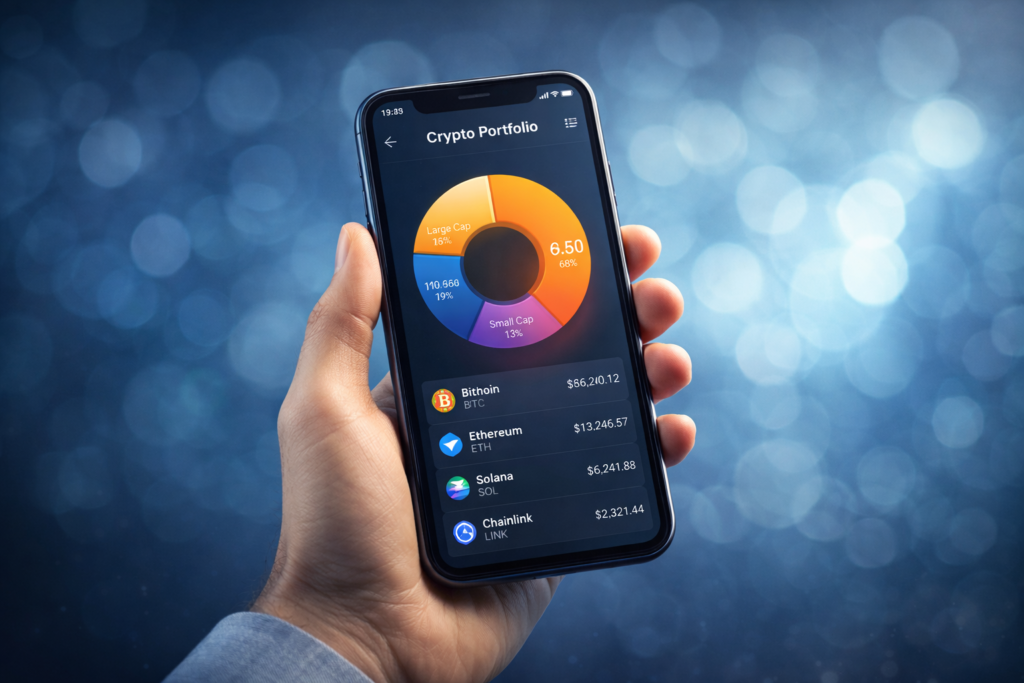
3. Diversify Across Categories
Consider allocating across large-cap (stability), mid-cap (growth potential), and small-cap (high risk/reward) cryptocurrencies based on your risk tolerance.
4. Check FDV for New Projects
For any project launched in the last 1–2 years, always check the FDV/market cap ratio to understand future dilution risk.
5. Monitor Total Market Cap Trends
A rising total market cap generally indicates money flowing into crypto. A falling total market cap suggests capital leaving the space. Use this as a macro indicator.
Ready to put this knowledge into action? Our guide on How to Buy Cryptocurrency walks you through the entire process step by step.
Key Takeaways
| 📊 Market cap = Price × Circulating Supply. It tells you the total value of a cryptocurrency, not just the price of one coin. |
| 📈 Size categories matter. Large-cap (>$10B) = more stable, lower growth. Small-cap (<$1B) = higher risk, higher potential reward. |
| 🚫 Don’t fall for the price trap. A “cheap” coin isn’t a bargain if its market cap is already massive. Always check the math. |
| 🔮 FDV shows the future. Compare market cap to fully diluted valuation to understand potential dilution from unreleased tokens. |
Frequently Asked Questions
What is a “good” market cap for a cryptocurrency?
There’s no single answer, it depends on your investment goals. Large-cap coins offer stability; small-cap coins offer growth potential with higher risk. Most beginners start with large caps like Bitcoin and Ethereum.
Can market cap go down even if no one sells?
Yes. Market cap is calculated using the current price. If the price drops (even due to low trading volume), the market cap drops too.
Is a higher market cap always better?
Not necessarily. Higher market cap means more stability but less room for explosive growth. Lower market cap means more risk but more potential upside. It’s about matching your risk tolerance.
Where can I check a coin’s market cap?
CoinMarketCap, CoinGecko, and most exchange apps display market cap prominently for every listed cryptocurrency.
What’s the difference between market cap and trading volume?
Market cap is the total value of all coins in circulation. Trading volume is how much was bought and sold in a given period (usually 24 hours). High volume indicates active trading and liquidity.
The Bottom Line
Market cap is one of the most fundamental metrics in crypto and understanding it separates informed investors from those flying blind. It tells you the true size of a project, helps you assess risk, and keeps you from falling into the “cheap coin” trap.
But remember: market cap is a starting point, not the whole picture. Combine it with research into tokenomics, use cases, team quality, and on-chain data to make well-rounded investment decisions.
The next time you see a coin’s price, don’t just look at the number, look at the market cap behind it. That single habit will make you a sharper, more disciplined crypto investor.
Disclaimer: This article is for educational and informational purposes only and should not be considered financial advice. Cryptocurrency investments carry significant risk. Always do your own research (DYOR) before making investment decisions.
